
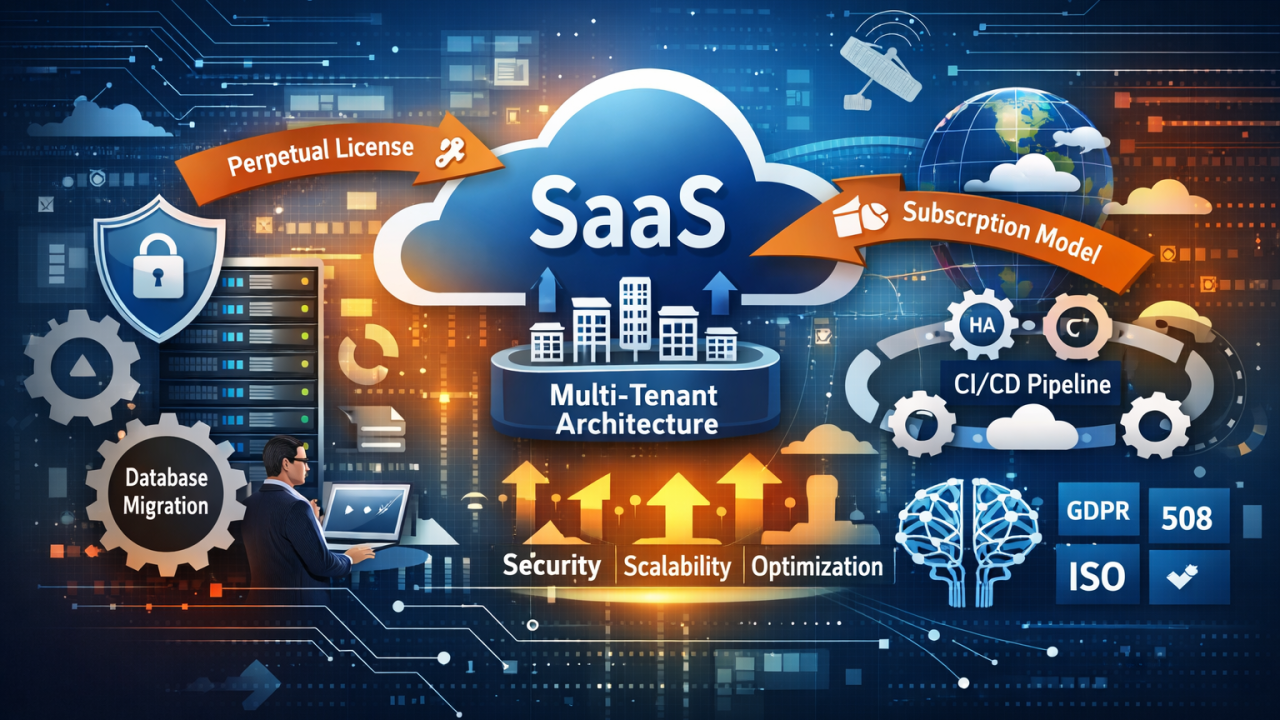
The current requirement of developing scalable SaaS platforms needs more than a cloud infrastructure; it requires intelligent systems that can be scaled, automated, and improved with user requirements. To improve their SaaS offerings, businesses are more and more integrating AI into their products to enhance performance, to personalise user experiences, and to unlock data-driven decision-making at scale.
AI in the context of the current SaaS platforms
Artificial Intelligence is not an add-on feature anymore; rather, it has become an intrinsic part of successful SaaS applications. Predictive analytics to automated workflows, AI facilitates platforms to provide smarter capabilities with limited human involvement.
With integrated machine learning models and other intelligent algorithms, SaaS products can analyse user behaviour, forecast trends, and make personalised recommendations. This is not only enhances user engagement but also assists businesses in keeping up with the fast-changing markets.
Scalability Construction on the First Day
The feature of scalability is the characteristic feature of any SaaS product. With the increase in user demand, the system has to be able to accommodate more loads without affecting performance. This is where a well-designed solution, which in many cases is provided by a trusted saas software development company, is critical.
SaaS platforms can scale effectively using cloud-native architectures, microservices, and containerisation. These systems can also be self-optimising by utilizing resources dynamically depending on usage patterns. When combined with AI capabilities, these systems can also self-optimise by managing resources dynamically based on usage patterns.
User Experience: Intelligent Features and Enhancements to the User Experience
SaaS products that are powered by AI are more intuitive and personalised to the user experience. Chatbots, recommendation engines, and smart dashboards are some of the features that ensure a seamless and efficient interaction.
As an illustration, AI can analyze the preferences of the users and provide them with personalized content or automate those processes, saving their time and enhancing their satisfaction. The intelligent features not only add value but also make your product stand out in the saturated market place.
Large-Scale Data-Driven Decision Making
SaaS solutions produce large volumes of data, and AI can be used to convert this data into useful insights. These insights can be used by businesses to advance their business, discover opportunities, and make wise decisions.
AI-powered advanced analytics tools have the capability to identify patterns, forecast, and deliver real-time reporting. This degree of intelligence helps organisations to react proactively and not reactively.
Security and Performance Optimisation
With the rise of SaaS platforms, the importance of ensuring security and performance is growing. AI plays a key role in identifying potential threats, detecting anomalies, and ensuring system stability.
Monitored automatically and predictive maintenance are used to eliminate downtime and provide a smooth user experience. This proactive strategy builds on reliability and trust on your platform.
AI Integration to Future-Proof SaaS
The future of SaaS is constant innovation, and AI is at the core of this revolution. By embedding smart technologies at the early stage, businesses can create platforms that are not only scalable but also adaptable to future needs.
By investing in the development of AI-based SaaS, the company will be guaranteed of long-term growth, increased efficiency, and a competitive advantage. It is no longer simply a matter of software delivery; it is a matter of creating smart ecosystems that can be changed with your users and business objectives.